AI fits into six jobs a marketing team runs every month: research, the brief, creative and ad variants, campaign setup, reporting and search visibility. In each one, AI does the legwork. A person keeps four calls: what you sell, what you say, what you spend and what goes live.
I run my own marketing this way, and I teach AI Mastery for Marketing, so I sell what this guide describes. The examples come from my campaigns and search records in September and October 2026.
Tool facts and prices checked 23 Oct 2026 on each vendor’s own pages.
From my campaigns, September and October 2026
- Ad concepts AI made for one webinar
- 13, and 7 of them ran
- Sign-ups from the best ad, first week
- 9 of 10
- Who switched the campaign on
- Me, at 14:14 on 9 Oct
- What I spend on AI tools
- About RM2,000 a month
Where does AI fit in a marketing team’s work?
I give AI the jobs that repeat every campaign and leave something I can check: a keyword list, a brief, an ad, a campaign build, a report, a page’s index status. Each job feeds the next, and what reporting and search turn up goes back into research.
- 01Research
- 02Brief
- 03Creative
- 04Setup
- 05Reporting
- 06Search
What reporting and search find goes into the next round of research
- Company
- Audience
- Voice
- Visual
| Job | AI does | You keep |
|---|---|---|
| Research | Sizes demand and reads the market | Which offers get a page |
| The brief | Drafts it from your brand files | The angle and every claim |
| Creative and ad variants | Makes the options and fixes faults | Which ads run |
| Campaign setup | Builds the campaign, paused | The budget and the switch |
| Reporting | Reads every row and finds gaps | Which number counts |
| Search visibility | Checks whether Google lists each page | What each page is for |
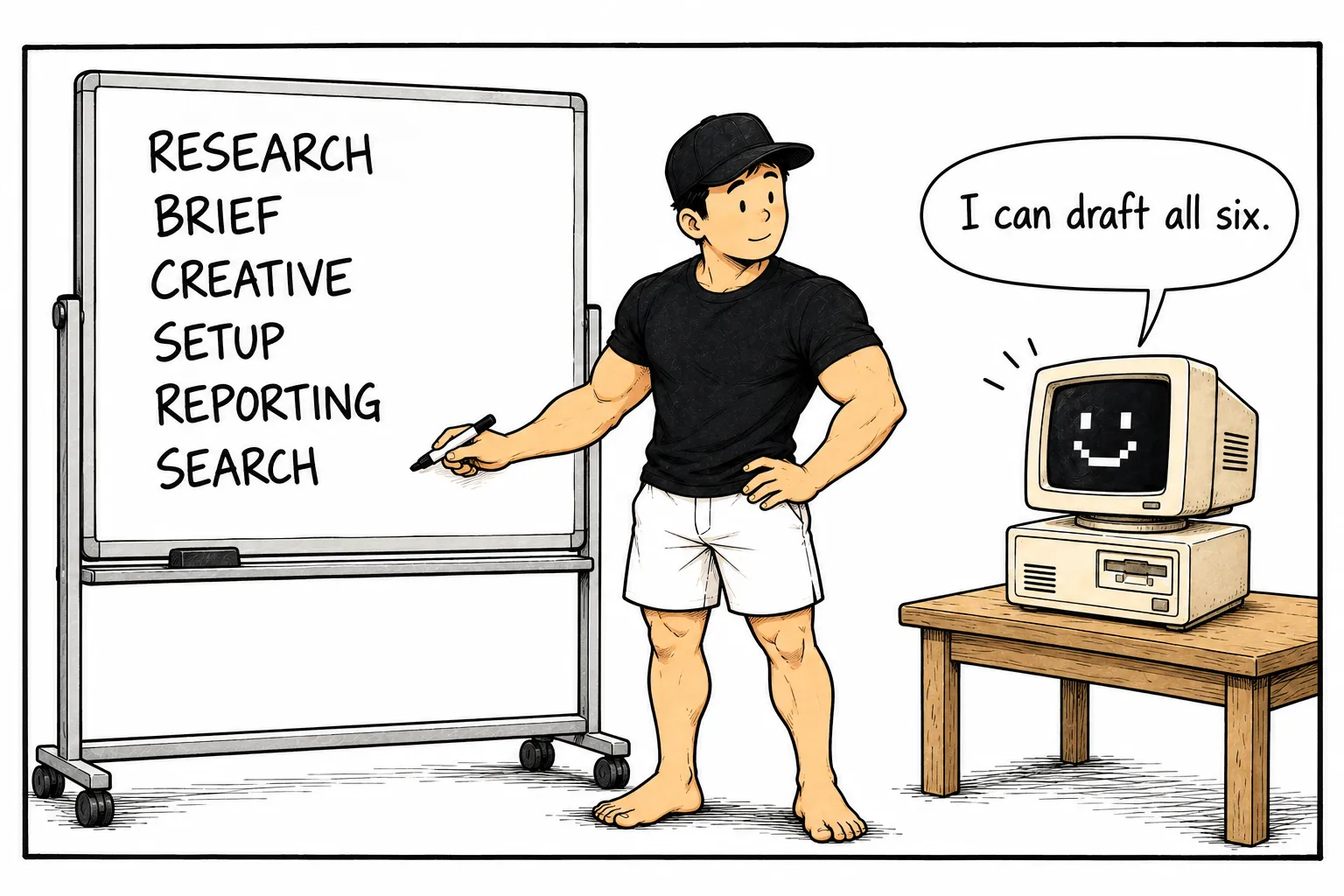
What does AI do in each marketing job?
In each job below, AI does the repeatable work and a person makes the call. Each one shows how it ran on my campaigns, and the tool I would start a team on.
1. Research: AI sizes the demand, you decide what to build
On 5 Oct, AI sized monthly Google searches for 36 terms in one run of Keyword Planner, Google’s free tool for search estimates.
A bigger number did not get a page. “ai for accountants” gets about 720 searches a month in Malaysia. “ai in digital marketing”, the term this page answers, gets about 210.
I turned the accountants page down, because I do not run a finance programme. A page that ranks for a course I do not sell hands the reader to someone who does.
You keep: which offers get a page. Demand shows how people phrase the question. Your offer decides whether you answer it.
The tool: Claude with Research. Research runs several web searches that build on each other, so it can read a market for you. It needs a paid plan and web search switched on. For search numbers, pair it with Keyword Planner, which needs a Google Ads account.
2. The brief: AI writes from your brand files, you set the angle
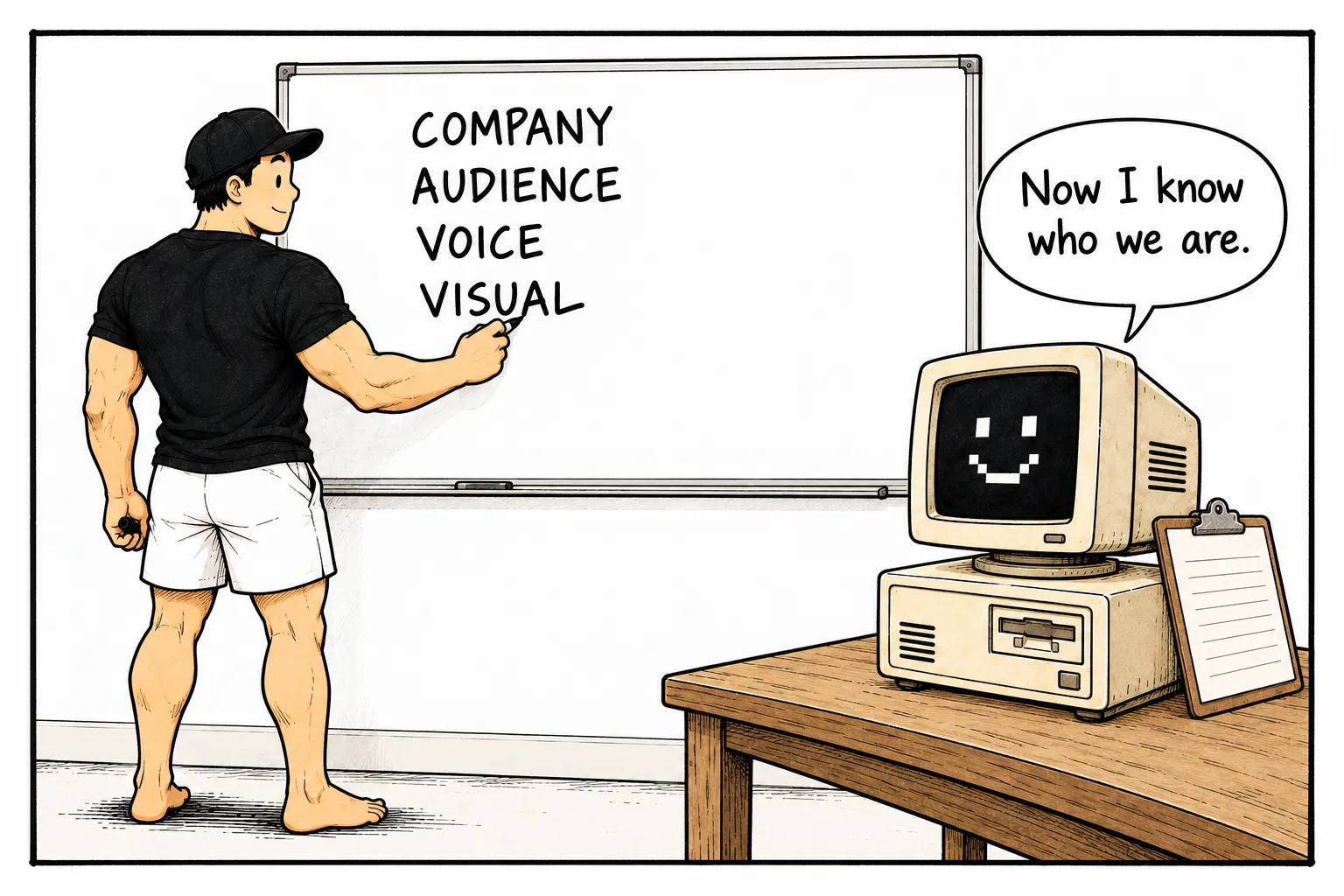
Before AI drafts anything for my business, it reads four brand files.
The four files every brief starts from
- Company
- Who we are, the team and our partners
- Audience
- Who buys, and the words they use
- Voice
- How I write, and the proof I can use
- Visual
- Colours, type, layout and the comic style
The files are where my corrections go. In June I banned “real” as an intensifier. In September I dropped an old revenue-uplift claim from my growth work, because too many causes share the credit. Each fix went into a file once, and every draft since has read it.
You keep: the angle and every claim. You decide which promises the company stands behind.
The tool: Claude Projects. A Project keeps its own chats, a set of files and standing instructions, so the brand files load into every chat in it. Free accounts get up to five Projects. On a Team plan, you can share them across the company.
3. Creative and ad variants: AI makes the options, you pick what runs
For my 21 Oct webinar for property agents, AI made 13 ad concepts: three posters on 6 Oct, then five more stills and five short videos.
AI checked each still at full size and at phone width. The checks caught large red fills, extra flags, a green speech bubble and a footer too small to read, and each faulty draft got one corrective edit.
My head of sales picked six for the launch, four of them from the 13 and two short videos rebuilt from an older demo. I added the first three posters back, so nine ran on Meta.
In the first week, 9 to 15 Oct, they spent RM193.32 and brought 10 sign-ups tagged as coming from Meta. Nine came from the comic still, at RM17.37 each.

Sign-ups by ad, 9-15 Oct 2026
Still and video are the comic ad. Rest is the other seven ads.
You keep: which ads run, and which ones stop.
The tool: Codex image generation. Codex, OpenAI’s coding agent, can generate and edit images with its built-in image model. Image turns use up your Codex limits three to five times faster on average than other turns, so plan your batches.
4. Campaign setup: AI builds it paused, you switch it on
On 9 Oct, AI built the webinar campaign through Meta’s API: the campaign, the ad set, the ads and tracking tags on every ad. It targeted Malaysia, ages 21 to 65, my list of 540 property agents plus a 1% lookalike, at RM30 a day. It built everything paused, so nothing could spend until I said go.
- 9 OctBuilt, pausedCampaign, ad set, ads, tracking tags
- 14:14LiveOn my go
- 14:25Six ads approvedThrough Meta review
- 14:43Goal changedA new campaign for website visits
Half an hour after launch, I changed the goal from leads to website visits. Meta refused the change on the live ad set, because its attribution setting cannot change once the ad set exists. AI built a website-visits campaign with the same audiences and ads, and it went live at 14:43 on my instruction.
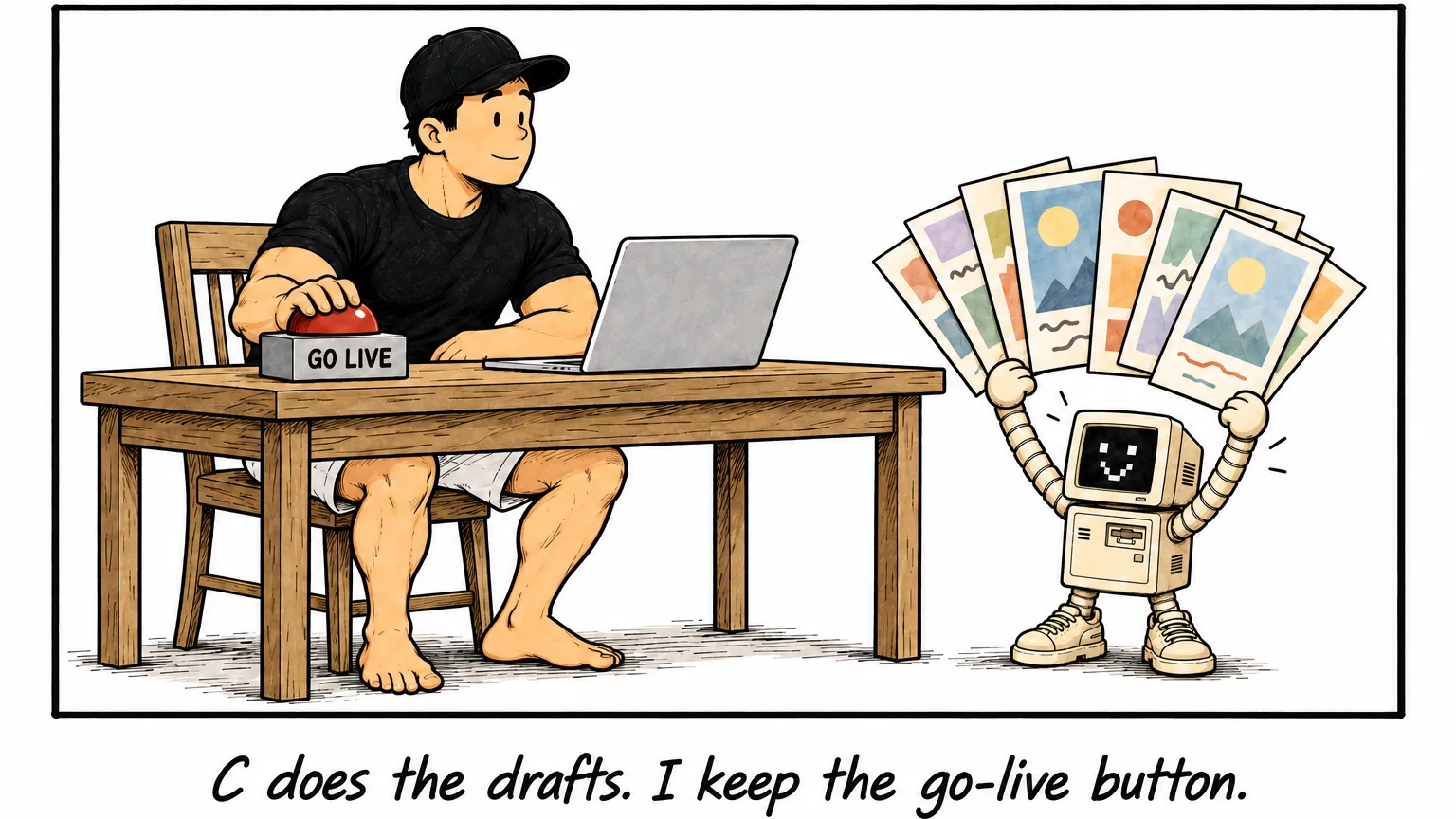
You keep: the budget and the switch. Turning a campaign on spends money, so that click stays with a person.
The tool: Meta’s Ads MCP server. MCP, short for Model Context Protocol, is an open standard for connecting an AI assistant to other apps. My guide to the building blocks of AI explains it. Meta hosts this connection itself. It lets an AI agent create and edit campaigns, ad sets and ads, with any assistant that supports MCP. I built mine through Meta’s API. Meta’s own server is where I would start a team.
5. Reporting: AI reads every row, you decide what counts
In early September, my home page’s Search Console clicks rose from 10 to 29 while GA4’s organic visits fell from 92 to 64. AI read the query rows behind the clicks.
Over 80% of the gain came from people outside Malaysia searching “jwt advertising” and “jwt agency”, meaning J. Walter Thompson, the advertising agency. Those clicks were never going to become my enquiries.
The mix-up continues: in the 90 days to 22 Oct, J. Walter Thompson searches showed my home page 1,029 times, against 106 for “jwt company”, which could mean either of us. So I report Search Console clicks and GA4 visits side by side, and never treat one as a stand-in for the other.
On the webinar, AI matched Meta’s lead events against my sign-up list hour by hour. They agreed, apart from four test sign-ups made on 15 Oct to check the form.
You keep: which number counts. For the webinar, I count completed sign-ups. Page views and clicks only show whether people are on the way.
The tool: Google’s Analytics MCP server. It lets Claude Code, Anthropic’s coding agent, or Gemini CLI run GA4 reports, including realtime and funnel reports. It is experimental, runs on your own computer, and only reads, apart from annotations you allow it to add.
6. Search visibility: AI checks every page, you choose what each page is for
On 23 Oct, AI inspected all 34 pages in my sitemap through Search Console: 26 were indexed, 8 were not. Five went back to Google for indexing the same day.
The other three wait on me: two old posts I have to keep or retire, and one that needs a link pointing at it first.
Search now includes AI answers, so AI checks those too. On 22 Oct, none of 12 AI answers to my fixed test questions named JWT. That is the baseline I measure against. It matters because more than half of Malaysian internet users aged 16+ use ChatGPT each month, (GWI, Q2 2026), as my roundup of Malaysia social media, search and AI statistics shows.
You keep: what each page is for, and which pages not to publish. I turned down a ranked list of AI training providers on my site, because an AI engine I tested discounted that kind of self-ranked list without being asked.
The tool: Google Search Console, free. It shows which pages Google has indexed, why the rest are not, and where to ask Google to look again.
What should stay with a person?
Four calls stay with a person, whatever the tool: what you sell, what you say, what you spend and what goes live. On the webinar, mine were few: adding three posters to the ads, approving RM30 a day, saying go at 14:14 and changing the goal at 14:43.
Sort eight tasks from my September and October campaigns, then see how I split them.
AI drafts it, or you decide?
Pick one answer per task. Each pick shows how I split it and why.
Size monthly demand for 36 search terms
AI drafts it. AI ran all 36 through Keyword Planner in one go on 5 Oct.
Make 13 ad concepts for one webinar
AI drafts it. AI made eight stills and five short videos, and AI checked each still at full size and at phone width.
Skip a page with 720 searches a month
You decide. I run no finance programme. Which offers get a page is a call about what you sell.
Build the campaign, its ads and the tracking tags
AI drafts it. AI built all of it, paused.
Choose which ads run
You decide. My head of sales picked six, and I added three.
Switch the campaign on
You decide. It went live at 14:14 on 9 Oct, on my go. Switching on spends money.
Find why two reports disagree
AI drafts it. AI traced the extra Search Console clicks to searches for another JWT.
Approve a rating claim for the website
You decide. A claim carries the company name. Only proof I can point to goes out, such as NP Digital's 4.7 out of 5 average rating.
What I would do: Connect AI to an ad account only after one named person owns the budget and the switch.
Which AI marketing tools does each job need?
Six tools cover the six jobs: two AI assistants and four tools from Google and Meta. I train teams on Claude or Codex, and neither is the default. In my use, Claude is stronger at reasoning and gives more room before its usage limits. Codex is stronger at image generation and at computer use, where it works the apps on your screen in the regions OpenAI supports.
One tool per job, with plan and price where published
- Research and briefs
- Claude, with Research and ProjectsResearch needs a paid plan. Pro is US$20 a month, or US$17 a month billed yearly.
- Creative and ad variants
- Codex image generationCodex comes with every ChatGPT plan, Free included. Plus is US$20 a month.
- Campaign setup
- Meta Ads MCP serverHosted by Meta, for any assistant that supports MCP.
- Reporting
- Google Analytics MCP serverExperimental, from Google. Runs on your computer and reads GA4.
- Search visibility
- Google Search ConsoleFree.
- Search demand
- Google Keyword PlannerFree, with a Google Ads account.
I spend about RM2,000 a month on AI tools across the business. A team does not need that to start: one paid assistant seat at about US$20 a month, plus the free Google tools, covers a first job. For a business owner’s wider tool list beyond marketing, see the best AI tools for small businesses in Malaysia.
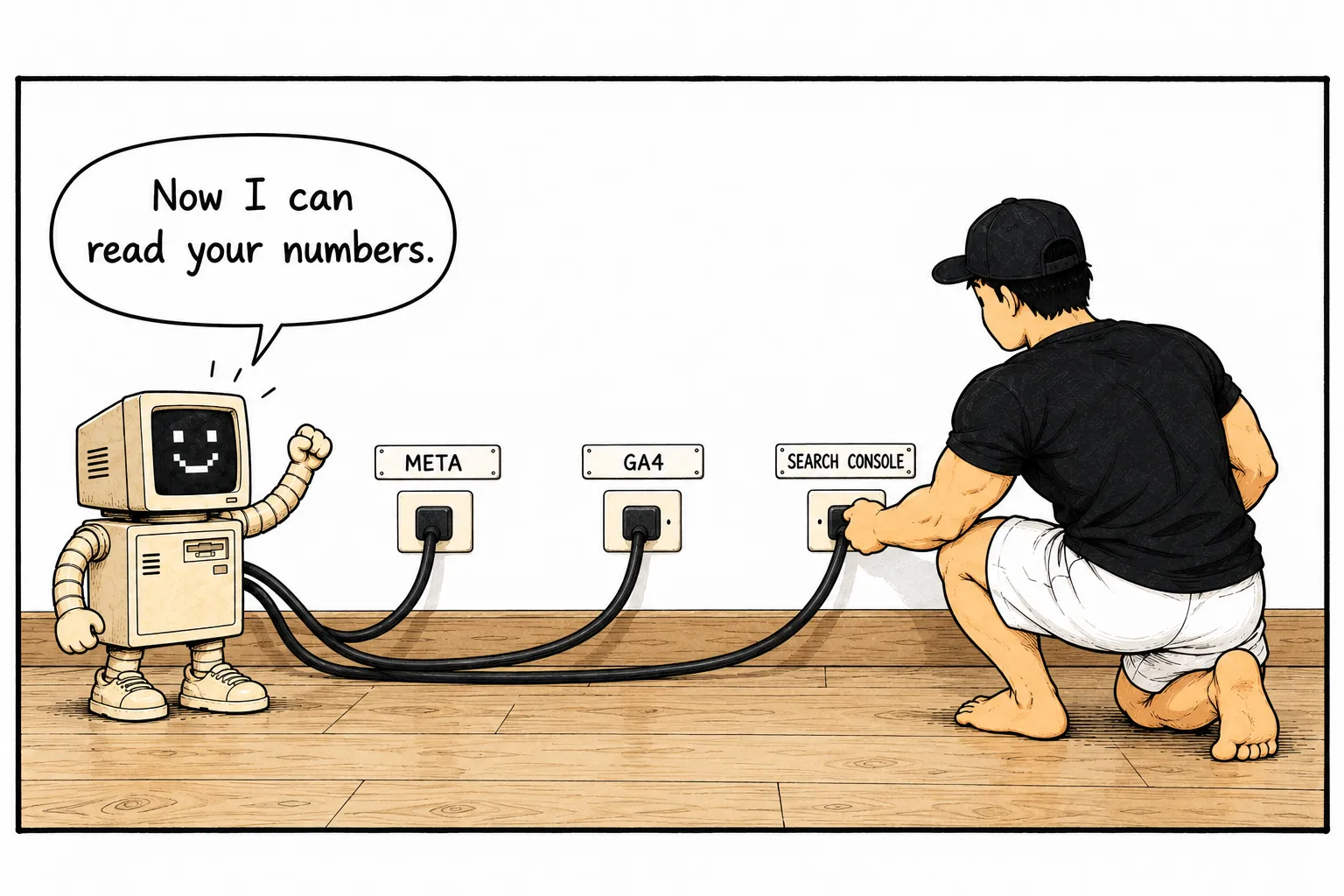
Where should your team start?
Write the brand files first, then run one job on a campaign you already shipped. Last month’s campaign makes the best test, because you already know what good looks like.
When the team is ready to learn the whole workflow, my guide to what an AI marketing course should teach sets out seven capabilities and the questions to ask a provider. To compare course formats first, see which type of AI course in Malaysia suits you.
Questions marketing leads ask about AI
Will AI replace my marketing team?
No. AI does the legwork in each job, and the four calls stay with people: what you sell, what you say, what you spend and what goes live.
Which AI tool is best for marketing?
Pick by the job: Claude for research and briefs, Codex for images and ad variants. My comparison of ChatGPT, Claude, Gemini and Copilot for teams sets out what each does well.
Can AI run Meta ads on its own?
It can build and edit campaigns, ad sets and ads, and Meta’s own Ads MCP server is made for that. Switching a campaign on and setting its budget should stay with a person.
Does my team need to code?
Not for the assistants: Claude and Codex take plain-language instructions. Some connections need a one-time technical setup: Google’s Analytics MCP server needs Python and a Google Cloud project.
References
Show all 10 sources
All sources checked 23 Oct 2026.
- Claude Help Center: Use research on Claude. Research on paid plans, several searches that build on each other, web search switched on.
- Claude: Pricing. Pro at US$20 a month or US$17 billed yearly, Team seats, Research and the Free Projects limit.
- Claude Help Center: What are projects? Chats, a knowledge base and instructions per Project, five on Free, sharing on Team.
- ChatGPT Learn: Image generation. Codex generates and edits images with a built-in model, and image turns use limits three to five times faster on average.
- ChatGPT Learn: Pricing. Codex on every ChatGPT plan, Free included, and Plus at US$20 a month.
- ChatGPT Learn: Computer Use. Computer use on macOS and Windows, in supported regions.
- Meta for Developers: Ads MCP Server. Meta-hosted, creates and edits ads, ad sets and campaigns, works with any MCP-compatible agent.
- Google Analytics MCP Server on GitHub. Experimental, runs locally, GA4 reports, read-only unless writing is allowed, setup for Gemini CLI and Claude Code.
- Search Console Help: About Search Console. Free, indexing problems and re-indexing requests.
- Google Ads Help: Use Keyword Planner. Monthly search estimates, with a Google Ads account.