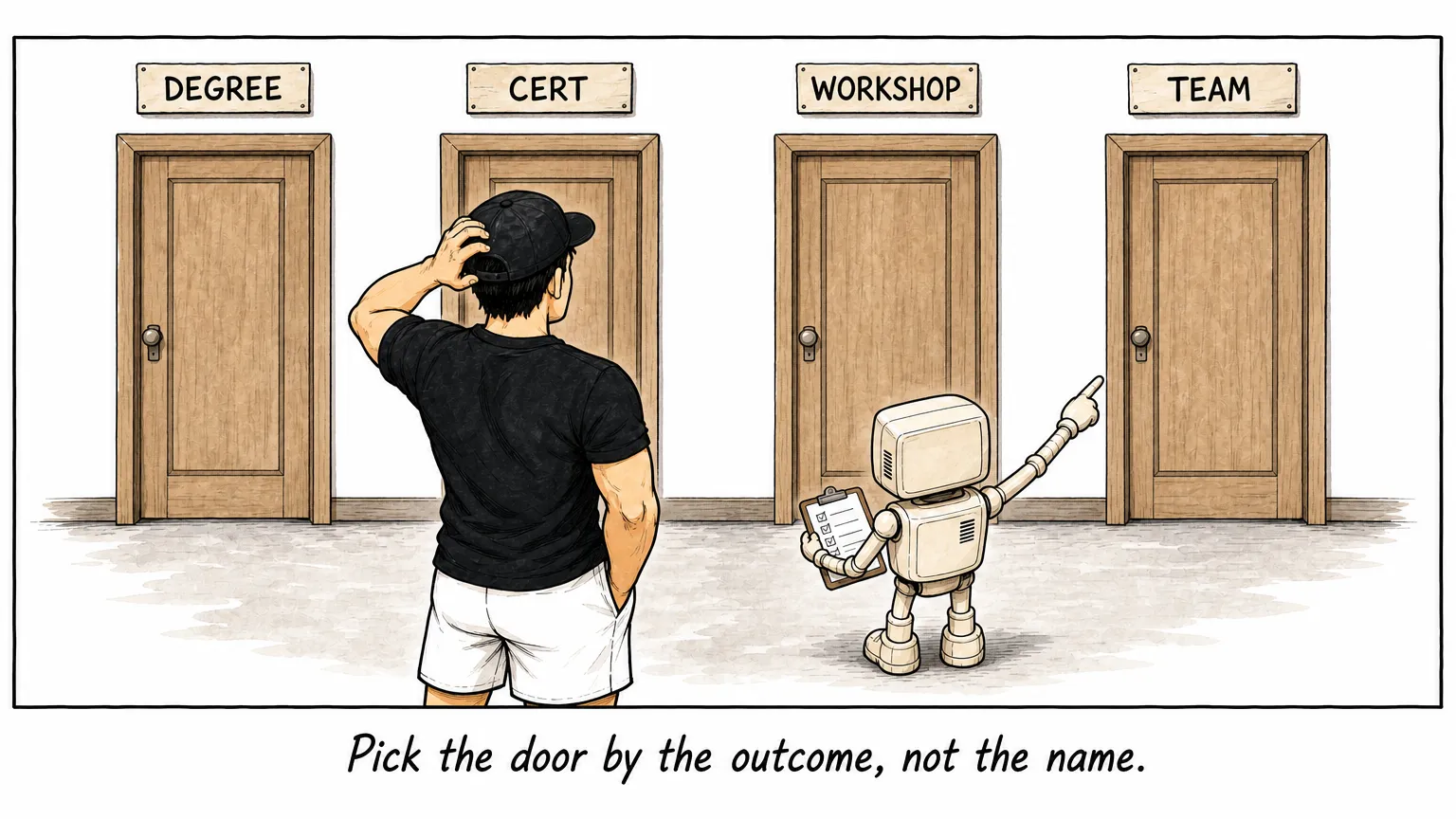
Searching for an AI course in Malaysia can lead to a degree, a vendor certification, a public workshop or private company training. They may all mention AI, but they solve different problems.
Choose the course by the result you need. A recognised qualification helps with an academic or technical career. A product certification tests knowledge of a named platform. A short course builds a focused skill. Private training helps a team improve work they already do.
Mixing those goals wastes time. A good university programme may be far too broad for a sales team that needs a working proposal process next month. A useful two-day workshop does not replace a formal qualification.
The quick comparison
| Course type | Best for | What it should prove | Main limitation |
|---|---|---|---|
| Academic qualification | Students and technical career changers | Completion of an accredited programme at a stated qualification level | Longer commitment and limited company customisation |
| Vendor certification | People working with a named platform or technical role | Knowledge or skills within the issuer’s published assessment scope | Product-specific and may require renewal |
| Micro-credential | Working adults closing a specific skills gap | Assessed learning in a defined area | Quality and recognition depend on the issuer and design |
| Public short course | Individuals and small groups | Practical learning within a narrow topic | Limited time with the participant’s company context |
| Private company training | Teams improving connected work | Repeatable workflows built around shared processes and rules | Requires preparation, safe material and follow-through |
Key takeaway: Start with the result you need after the course, then verify what the provider assesses.
What “AI course” means in Malaysia
The word “course” does not tell you what the learner receives. Look for the issuer, assessment, recognition and practical output.
An academic programme sits within a formal qualifications system. The Malaysian Qualifications Register is the official reference for programmes and qualifications accredited under the Malaysian Qualifications Agency Act. Search the register by programme and institution before relying on an accreditation claim.
A micro-credential is narrower. MQA describes it as certification of assessed knowledge, skills and competencies in a specific area. It may come from part of an accredited programme or from a standalone course. Ask which kind it is and whether it carries credit toward a wider qualification.
A vendor certification belongs to the company or professional body that issues it. Its value depends on the assessment, the role it targets and whether the employer uses that product. Read the issuer’s current exam and renewal rules rather than assuming that every badge works the same way.
A certificate of completion may only confirm attendance. That can still document learning, but it does not automatically mean MQA accreditation, vendor certification or tested job capability. The AI certification guide for Malaysian employers explains how to tell them apart.
HRD Corp claimability is another separate check. The scheme helps registered employers fund eligible employee training. Treat claimability as a funding question, not proof that a course is an academic qualification or a vendor certification. The step-by-step HRD Corp claim guide for AI training covers the approval window, and the AI training cost guide shows how the levy offset changes the net price. Malay-language readers can start with the panduan kursus AI untuk syarikat.
The main course types
1. Choose an academic AI programme for a formal qualification
An academic programme is the right route when the learner needs a certificate, diploma, degree or postgraduate qualification recognised within Malaysia’s higher education system.
This route suits someone building a technical foundation in computing, data, mathematics, machine learning or software development. It also makes sense when a future employer or further study programme requires a named qualification level.
Check the exact programme in the Malaysian Qualifications Register. Similar course names at different institutions do not prove equal accreditation status.
2. Choose a vendor certification for a named platform or role
A vendor certification fits a person who must administer, build with or support a specific technology stack.
The syllabus and assessment scope should be public. The employer can then compare the credential with the actual job. A cloud engineer working in an established Microsoft or AWS environment may gain more from a relevant vendor certification than from a general AI workshop.
The credential may age as the product changes. Check its issue date, renewal rules and current exam scope. If the company has not chosen its main tool, compare ChatGPT, Claude, Gemini and Codex for business training before buying product-specific training. If the team is choosing its everyday assistant, the ChatGPT vs Claude vs Gemini vs Copilot comparison for teams gives a verdict by use case.
3. Choose a micro-credential for a defined skills gap
A micro-credential can suit a working adult who needs assessed learning in a smaller area without committing to a full academic programme.
The useful questions are concrete: What knowledge or skill is assessed? Who issues the credential? Is it part of an accredited programme or standalone? Can another institution or employer verify it? Does it carry academic credit?
Do not rely on the word “micro-credential” alone. Read the learning outcomes and assessment method.
4. Choose a public short course for individual capability
A public short course works well when one or two people need a structured introduction or one practical skill.
It may cover research, document work, prompting, spreadsheets, basic automation or a named AI tool. A mixed class can expose participants to examples from other industries.
The constraint is company context. A public trainer cannot redesign the session around one organisation’s files, policies and systems. Ask what each participant will build and keep, because a useful short course should produce more than notes and sample prompts.
5. Choose private company training for a shared way of working
Private training is the stronger fit when several people work on connected processes.
The company can choose relevant tasks, prepare safe sample files, agree on approved tools and decide where human review is required. Participants can then test the same method against the same operating context.
Good candidates include meeting notes to actions, proposal drafts, weekly reporting, customer enquiry responses and onboarding packs. These AI workflow automation examples for business teams show what the work can look like.
The course should end with named outputs: a saved workflow, the context it needs, a fresh test, a review checklist, an owner and a date for the next run. That is a better test of team capability than attendance alone.
Match the format to your decision
| Your decision | Best starting point | Check before paying |
|---|---|---|
| “I want a technical AI career” | Accredited academic programme | MQR listing, curriculum, entry requirements and graduate pathway |
| “My role uses one established platform” | Relevant vendor certification | Issuer, exam scope, practical labs and renewal rules |
| “I need one assessed skill” | Micro-credential | Assessment, issuer, verification and credit status |
| “I want a practical introduction” | Public short course | Participant outputs, class size and hands-on time |
| “Our team needs to improve a process” | Private company training | Pre-work, company context, safeguards and follow-through |
For a Malaysian SME, readiness matters as much as format. Use the AI training readiness guide for SMEs to check tools, data, process ownership and time after the course, or take the two-minute AI readiness assessment for a scored read.
Price should come later. A cheap course that solves the wrong job costs more in lost time than a well-matched course with a clear outcome.
If the learning goal is already clear but the session format is not, compare these 12 hands-on AI workshop formats for companies by the output each one produces.
Questions to ask a training provider
- What should the learner be able to do afterwards?
- What will they build during the course?
- How is learning assessed?
- Who issues the qualification, credential or completion certificate?
- Can the result be independently verified?
- Will participants use realistic work material?
- How will accuracy and quality be checked?
- What information should not be uploaded?
- Which steps still require human approval?
- What does the learner keep after the course?
- What support exists after the session?
Ask the provider to show a sample assessment or participant output. A syllabus full of tool names tells you little about whether the learner will be able to use those tools at work.
For a practical programme, compare the answer with what a useful two-day AI for Business course should cover, then check it against what a two-day AI for Business agenda actually looks like hour by hour.
What should a business team leave with?
For company training, look for six concrete outputs:
- One repeated process selected per participant or pair.
- Reusable instructions for that process.
- Relevant company context organised for reuse.
- At least one test on fresh input.
- A list of human checks and approval points.
- A named owner and next-use date.
These outputs are useful even when the software changes because they belong to the work. They also give the company something it can review after 30 days.
If your team needs this outcome, review the AI Mastery for Business training programme. Bring one repeated process and judge the course by what participants can run again afterwards.