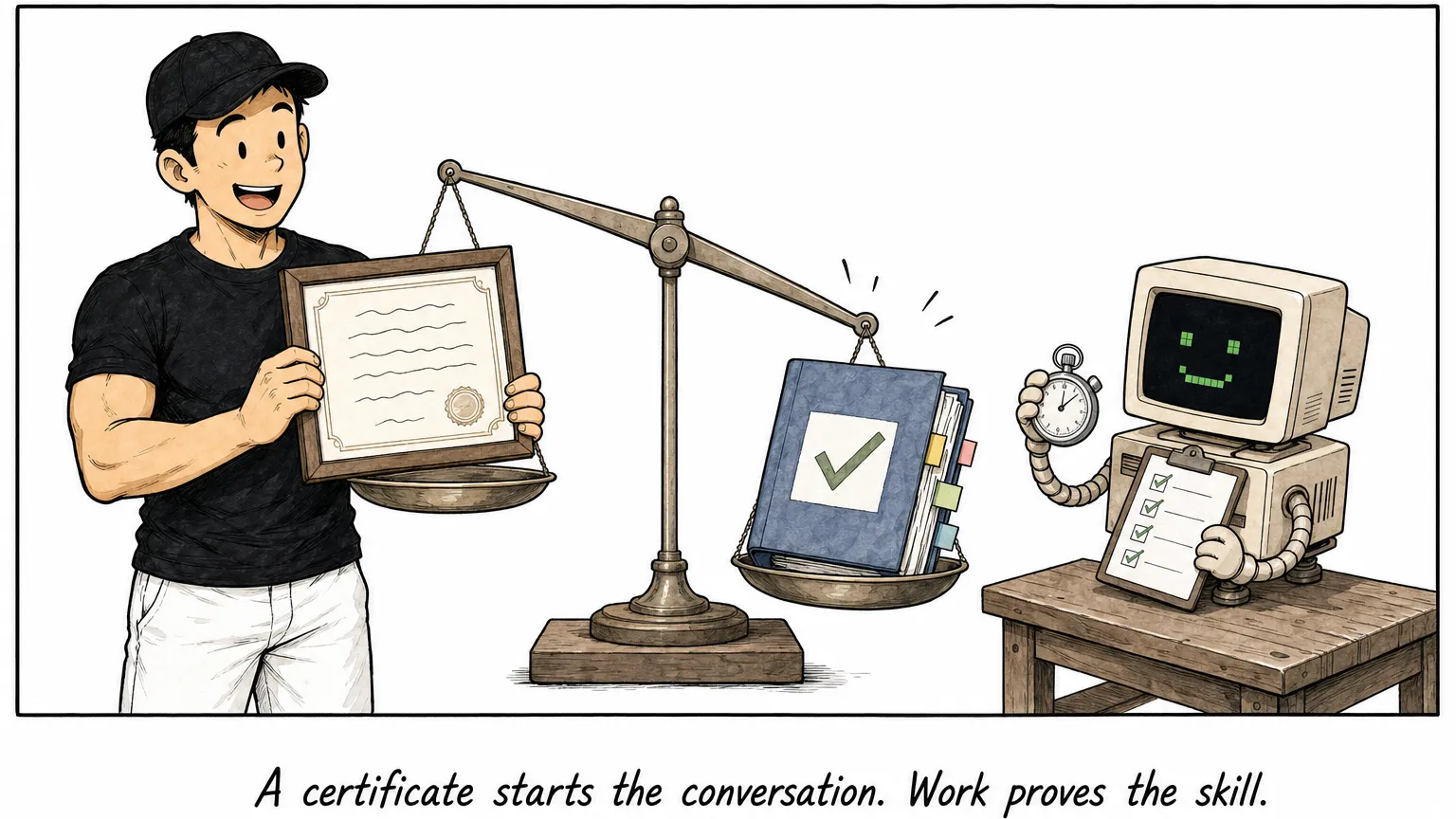
An AI certification in Malaysia can refer to an academic qualification, a vendor exam, a micro-credential or a trainer’s certificate of completion. Employers should not treat them as interchangeable.
Start with the job. Write down what the employee needs to do, then check whether the credential assesses that capability.
A certificate can be useful evidence. It is rarely enough on its own for work that depends on company context, judgement and repeatable execution.
The quick answer
Check five things before paying for or rewarding an AI certification:
- Issuer: Who awards and verifies it?
- Assessment: What must the learner submit or pass?
- Scope: Which tool, role or capability does it cover?
- Currency: Does it expire or require renewal?
- Job evidence: Can the learner apply it to a relevant task?
| Credential | Strongest evidence | What it does not prove by itself |
|---|---|---|
| Academic qualification | Completion of an accredited programme at a stated level | Current skill with every commercial AI tool |
| Vendor certification | Knowledge or skills within the vendor’s assessment scope | Ability to redesign a company workflow |
| Micro-credential | Assessed learning in a specific area | Broad qualification or employer fit |
| Completion certificate | Attendance or completion of a provider’s course | Independent assessment or accreditation |
Key takeaway: The name on the certificate matters less than the issuer, assessment and evidence behind it.
What each credential proves
Academic qualification
An academic certificate, diploma or degree can provide formal recognition at a stated qualification level.
In Malaysia, use the Malaysian Qualifications Register to check programmes and qualifications accredited under the Malaysian Qualifications Agency Act. Search the exact programme and institution. A similar title at another provider is not the same record.
This route is strongest when the role requires formal study in computing, data, mathematics, machine learning or a related discipline.
Vendor certification
A vendor certification assesses knowledge or skills defined by the company that owns the product or platform.
This can fit a role tied to an established technology stack. The employer should compare the current exam outline with the employee’s actual responsibilities. A badge aimed at cloud administrators may carry little evidence for a marketing manager who needs to research, draft and review campaigns.
Check renewal rules. They differ even within one issuer. Microsoft says its role-based and specialty certifications are valid for one year, while fundamentals certifications do not expire. The rule for another credential may be different.
Micro-credential
MQA defines a micro-credential as certification of assessed knowledge, skills and competencies in a specific area. It may come from part of an accredited programme or from a standalone course.
Ask whether the micro-credential carries credit, who assesses its quality and how another employer can verify it. The label alone does not answer those questions.
Certificate of completion
A training provider may issue a certificate showing that a participant attended or completed a course.
That record can support an employee’s learning history. It does not automatically mean the course is MQA-accredited, part of the Malaysian Skills Certification system or certified by a technology vendor.
The provider should state plainly what the certificate represents. Employers should ask for the assessment and participant output when practical skill is the reason for training.
Keep three Malaysian checks separate
Malaysia has several systems that answer different questions.
| Check | Question it answers | Where to verify |
|---|---|---|
| MQA accreditation | Is this higher education programme accredited and listed? | Malaysian Qualifications Register |
| Malaysian Skills Certification | Is this a skills qualification under the Department of Skills Development system? | DSD and MySPIKE records |
| HRD Corp claimability | Can an eligible employer seek training funding under the scheme? | HRD Corp and e-TRiS |
Claimable does not mean academically accredited. HRD Corp’s scheme supports employer training and has its own programme and claim requirements. MQA maintains the national register for accredited higher education programmes and qualifications. Check both when both matter. The claim side has its own timeline; see how to claim HRD Corp for AI training.
The same logic applies to a course that includes the word “certified” in its title. Ask who certifies it and where that status can be verified.
For a wider comparison of degrees, certifications, public workshops and private training, use the AI course guide for Malaysia.
Assess the credential against the job
Build a simple evidence map before choosing a course or screening a candidate.
| Job need | Useful assessment evidence | Practical follow-up |
|---|---|---|
| Use a named AI platform safely | Current product exam or assessed lab | Complete a relevant task in the approved company account |
| Research with sources | Assessed research exercise | Produce a sourced brief and verify every claim |
| Build a repeatable workflow | Project using instructions, context and checks | Run it again on fresh company material |
| Automate across systems | Assessed build with permissions and failure handling | Test restricted access, bad inputs and recovery |
| Lead AI adoption | Governance, process and measurement work | Set owners, controls and a 30-day adoption review |
The follow-up matters because AI work changes with the input and context. A learner may understand a concept and still need practice applying it to the company’s files, standards and approval process.
If the company is still choosing its platform, compare ChatGPT, Claude, Gemini and Codex for business training before committing to a product-specific credential.
What practical capability looks like
For business teams, ask the learner to show a small piece of real work after the course.
A useful capability check could require the employee to:
- Choose one repeated task.
- Prepare safe, relevant context.
- Write reusable instructions.
- Produce an output in the company’s format.
- Test it with fresh input.
- Document errors and human checks.
A formal exam and a practical check answer different employer questions. The practical check shows whether the employee can use the learning responsibly at work.
The AI training readiness guide for Malaysian SMEs helps a company prepare approved tools, safe material, process ownership and follow-through before training begins.
Questions to ask a provider or candidate
Questions for the provider
- Who issues the credential?
- What does the learner have to pass or submit?
- Is the assessment independently verified?
- Can an employer confirm the credential online?
- Does it expire or require renewal?
- Is it tied to one product version?
- Is it MQA-accredited, part of Malaysian Skills Certification, HRD Corp claimable, or none of these?
- What will the participant build and keep?
Questions for the candidate or employee
- Which parts of the course did the assessment test?
- What can you do now that you could not do before?
- Show one output and explain how you checked it.
- Which data should the workflow never receive?
- When would you stop and ask a person to decide?
- Can you run the same process on fresh input?
A credible answer includes limits. Someone who can explain when the method fails is more useful than someone who only repeats the course terminology.
Make the course decision
Choose an accredited academic programme when the learner needs a formal qualification. Choose a vendor certification when the job uses that vendor’s platform and the assessment matches the role. Choose a micro-credential for a defined, assessed skills gap.
Choose practical training when the team needs to change a workflow. The certificate may record completion, but the business outcome should be visible in the work participants can run again.
Review what a useful two-day AI for Business course should cover to compare practical outcomes. If your team wants to build those workflows together, see the AI Mastery for Business training programme.