“Is this HRD Corp claimable?” is the first question I get on most AI training enquiries.
Claimability is rarely the hard part. Timing is. Since 15 June 2026, the grant has to be approved before the training runs, and an approved HRD Corp Claimable Courses grant can no longer be modified.
The question worth asking is when to submit and what goes in.
This guide walks the sequence from levy eligibility to the claim after training. Every rule cites an official HRD Corp source with the date I checked it. Where the published guidance does not answer a question, I say so rather than fill the gap.
The quick answer
- Confirm the employer is registered, has no levy arrears, and has enough levy balance.
- Fix the dates, venue, participants and scope first, because an approved grant cannot be amended.
- Apply in e-TRiS before the training start date, with the quotation, course content and schedule, and trainer profile.
- Answer any HRD Corp query within five days, or the application expires and is rejected.
- Wait out the approval window. In-house training can be conducted 14 days after approval and must start within 90 calendar days after that.
- Run the training, minimum four hours, with attendance recorded daily.
- Submit claims within six months of the training completion date.
Key takeaway: Approval must land before the training, so choose the date backwards from the 14 day window instead of forwards from the enquiry.
HRDF, HRDC or HRD Corp?
They are the same scheme under different names. HRD Corp’s own About Us page puts it plainly: “In April 2021, HRDF became Human Resource Development Corporation (HRD Corp).” HRDC is a common short form of the new name.
The old name lingers for a reason. Many employers and providers still say “HRDF claimable”, and HRD Corp still calls its internal grant mechanism the Human Resources Development Fund. Whichever name your finance team uses, the rules below are the current HRD Corp rules.
Check eligibility before you fix a date
Five checks decide whether an employer can apply at all. None of them are about the course.
| Check | What HRD Corp states | Source |
|---|---|---|
| Registration | Compulsory for employers with 10 or more Malaysian employees; optional for 5 to 9 | HRD Corp Employers FAQ |
| Levy rate | 1% of total wages for the mandatory category, 0.5% for optional registrants | HRD Corp Employers FAQ |
| Levy started | The scheme is open to registered employers who have paid levy for the first month | Allowable Cost Matrix guidebook |
| No arrears | Employers with levy arrears or levy interest cannot apply, in line with Section 20.5 of the PSMB Act 2001 | HRD Corp Claimable Courses FAQ |
| Enough balance | Employers with insufficient levy balance cannot apply | HRD Corp Claimable Courses FAQ |
Levy is payable by the 15th of each month. An employer sitting on unused levy also carries a forfeiture risk: HRD Corp’s published rule forfeits the balance above RM10,000 where no training claim has been submitted within a two year period.
If the format itself is still open, settle that before the paperwork. The guide to which type of AI course in Malaysia is right compares public seats, in-house cohorts and academic routes.
The seven steps in detail
Each step has one owner. Most delays I see come from the wrong person waiting on the other.
1. Confirm eligibility and levy balance
The employer does this, not the provider. Check registration status, arrears, and the balance in the employer’s e-TRiS account.
An employer with arrears cannot apply, so a levy payment may need to clear before anything else moves.
2. Lock the training details before you apply
This step did not matter much before June 2026. It matters now.
For HRD Corp Claimable Courses, HRD Corp states that employers are no longer permitted to modify an approved grant. To change anything, the employer must cancel the approved grant and submit a new application.
So the dates, venue, participant list and scope should be settled in one decision meeting, not drifted into.
3. Collect the application documents
HRD Corp lists three documents for the application: quotation or invoice, training schedule or course content, and the trainer profile.
The Allowable Cost Matrix guidebook adds detail: course content with the training schedule including date and time, an accredited trainer profile, an invoice or quotation for course fees, and a quotation for chartered transportation if any.
4. Submit in e-TRiS before the training date
Grant applications must be submitted by the registered employer, online, before the training commences. Training providers do not submit the grant.
HRD Corp’s published service level for grant approval is 48 hours, provided the documents submitted are complete. That figure comes from a 2021 FAQ, so treat it as an indication rather than a promise.
5. Answer any query within five days
A grant officer can query an application when the information is insufficient, inaccurate or unclear.
Employers then have five days to respond and resubmit. HRD Corp states that failure to do so results in the expiry of the application and subsequent rejection.
This is the biggest reason to apply early. A query that lands while your approver is on leave can cost you the booking.
6. Wait out the approval window, then run the training
For in-house programmes, effective 15 June 2026, training can be conducted 14 days after grant approval. The approved programme must commence within 90 calendar days after the completion of that 14 day advance approval requirement.
Public programmes have a temporary exception: they can be conducted three days after grant approval, from 15 June to 31 December 2026. From 1 January 2027 public training returns to the 14 day rule.
Funding covers in-house or public training of a minimum duration of four hours.
7. Record attendance, then claim within six months
Attendance records are claim evidence. HRD Corp requires an Attendance T3 Form as proof of employee attendance, and the support centre states the attendance list must be signed by trainees on a daily basis. Remote online training instead needs a system generated report showing the training date, trainee name and precise clock in and clock out timestamps.
After training, the provider completes the Joint Declaration 14 Form, approved by a manager level official or higher, and invoices HRD Corp for the course fee. The employer claims its own allowances.
Claims must be submitted within six months from the training completion date. The published service level for claims is eight working days when the documents are complete.
What gets applications rejected
HRD Corp does not publish one consolidated rejection list. The conditions below are each stated in its own guidance, and together they cover most first time failures.
- The application went in after training started. It must be submitted before the training date commencement.
- The employer has levy arrears or levy interest.
- The employer has insufficient levy balance.
- The employer has legal issues with HRD Corp.
- The course is not registered with HRD Corp. Grants are not approved for unregistered courses, even from a registered provider.
- The trainer does not hold accreditation status. Effective 1 January 2025, HRD Corp certified active trainers must acquire accreditation to deliver training in the HRD Corp ecosystem, except speakers at conferences and seminars.
- A query was not answered and resubmitted within five days.
- Documents were incomplete, which is the stated condition on the approval service level.
Claimability is a funding status. It says nothing about academic recognition. If you also need a recognised qualification, read what employers should look for in an AI certification.
What your training provider prepares
The employer owns the e-TRiS submission. The provider’s job is to make that submission complete on the first try.
For a two day AI programme, I prepare the quotation, the course content with a dated and timed training schedule, and the accredited trainer profile. After delivery I prepare the T3 attendance record, the Joint Declaration 14 Form, and the invoice for the course fee.
I do not start training before approval is confirmed. HRD Corp’s own FAQ says providers should only conduct training upon receiving the grant approval confirmation, to avoid issues with the provider’s claims if the application is rejected.
Nobody can promise approval. HRD Corp evaluates each application on its own. What a provider can control is document quality and lead time.
Two cross checks before you commit: the criteria in how to choose an AI trainer in Malaysia, and the readiness steps in the AI training guide for Malaysian SMEs.
Plan the date backwards
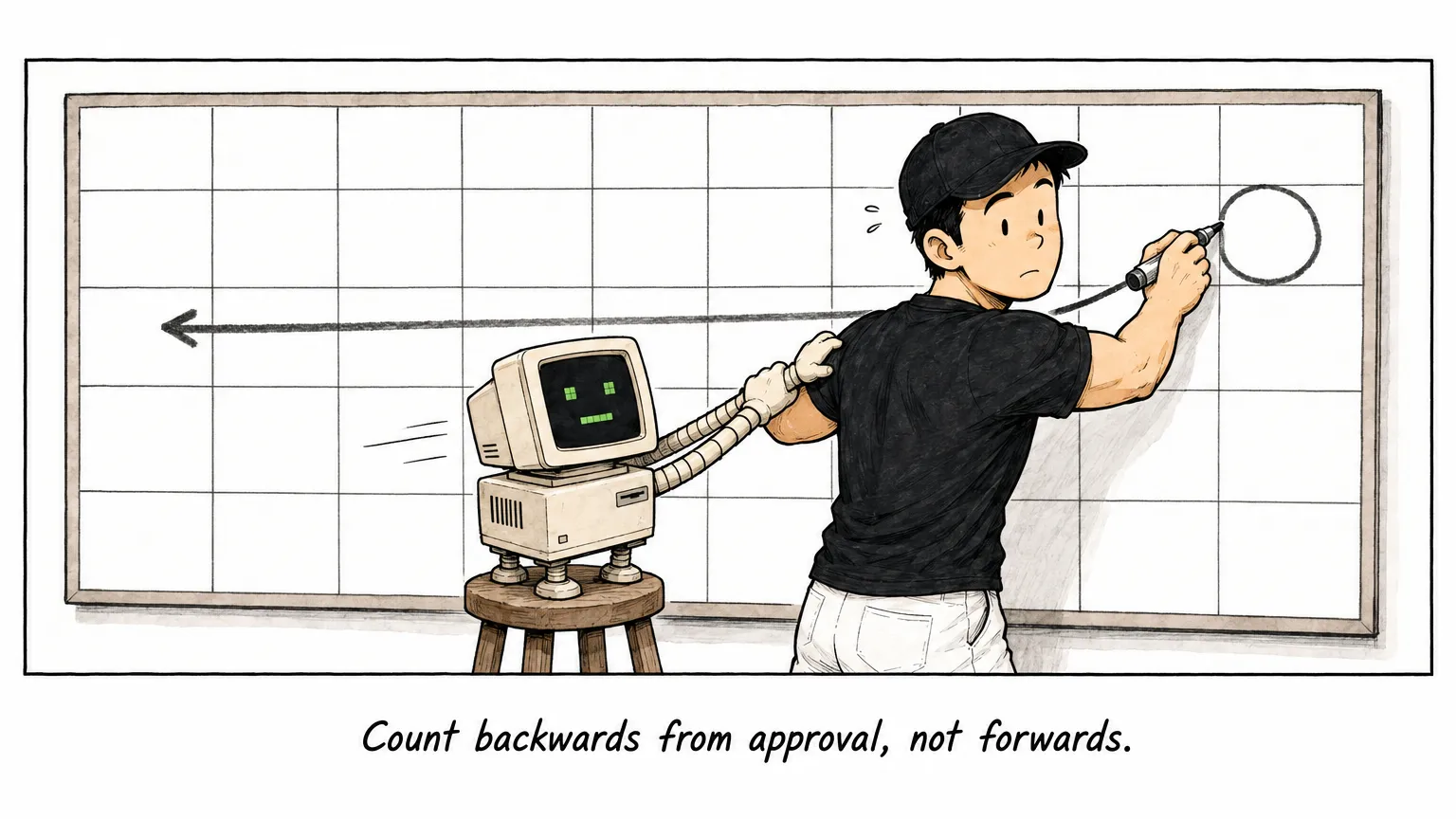
Take your preferred training date and count backwards. Fourteen days for the approval window. A few more for evaluation. Another five in case a query lands. Three weeks of lead time is the assumption I plan bookings around.
Three gaps a reader should check for themselves:
- The Employers’ Circular No. 2/2026 PDF did not resolve when I checked on 4 September 2026. The current timeline sits on HRD Corp’s own HRD Corp Claimable Courses page instead.
- The Allowable Cost Matrix guidebook dated September 2025 still says employers must submit grant applications “at least one day prior to the start of training”. The claimable courses page carries the newer rule. Where two official sources disagree, ask HRD Corp before relying on the older one.
- HRD Corp does not publish a processing time for the 2026 rules. The 48 hour figure comes from a 2021 FAQ.
Get the eligibility and the calendar right, and the rest is document quality. That frees you to argue about the part that decides value: what your team can do afterwards. What a two day AI for Business course should cover is the better place to spend the argument.
If you want the training details and documents prepared to fit this sequence, see the AI Mastery for Business training programme.
References
All sources accessed 4 September 2026 unless noted.
-
HRD Corp: About Us - the April 2021 change from HRDF to HRD Corp, and the Human Resources Development Fund as the internal grant mechanism. Accessed 17 September 2026.
-
HRD Corp Claimable Courses - application process, required documents, minimum four hours, the 14 day and 90 day rules, public training exception to 31 December 2026, six month claim deadline.
-
HRD Corp Employers FAQ - mandatory registration at 10 or more Malaysian employees, optional registration at 5 to 9, 1% and 0.5% levy rates, payment by the 15th of each month.
-
HRD Corp Support Centre: Levy Calculation Guideline - levy liability under Section 14 of the PSMB Act 2001 and the calculation base.
-
HRD Corp Support Centre: Levy Forfeiture - forfeiture of balances above RM10,000 where no claim is submitted within two years.
-
HRD Corp Support Centre: Guidelines To Attend To Grant Query - what a query is, the five day response window, and expiry then rejection.
-
HRD Corp Support Centre: General FAQs, Grant and Claim Application - employers submit grant applications before training commences; the T3 attendance list signed daily; JD14 form.
-
HRD Corp Grant Application Helper: Grant Modification - approved HCC grants can no longer be modified; cancel and reapply.
-
Allowable Cost Matrix Guidebook, September 2025 - required supporting documents for grant and claim submission, no arrears and no legal issues, trainer accreditation from 1 January 2025.
-
FAQ HRD Corp Claimable Courses, Version 4 - levy arrears and insufficient balance bar an application, unregistered courses are not approved, 48 hour grant service level, eight working day claim service level, providers should not train before approval.
-
HRD Corp Guidelines - index of current grant helpers, claim helpers and the Allowable Cost Matrix.