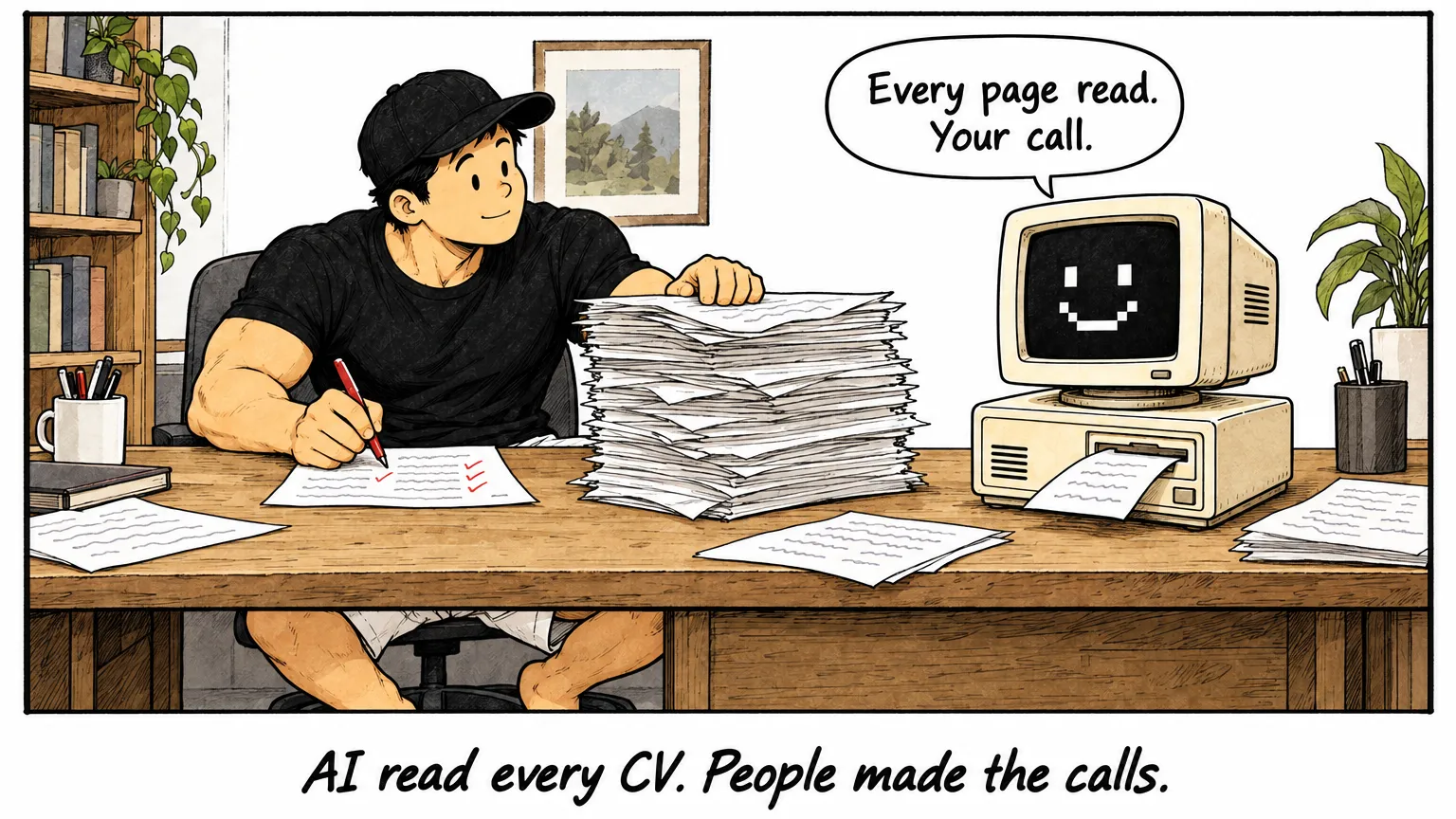
I screened 300+ job applications for a client with AI in 2026. The applicant data from the job board, Hiredly, was incomplete, so Claude read each CV PDF in full and scored it against a written role profile.
I built the workflow, set the scoring weights and confirmed the shortlist. I checked some CVs by hand to confirm the AI’s reading and scores. The top candidates were interviewed in person, and the client filled both roles it had open.
This page is for an HR manager deciding whether to try AI for CV screening. It shows each step and who did it, what went wrong, and what my next round adds under Malaysia’s new guideline on automated decisions.
- Applications screened
- 300+For one client in 2026
- Roles filled
- 2 of 2Both roles the client had open
- What the AI did
- Read every CV and scored itAgainst a written role profile
- What I did
- Set the weights, confirmed the shortlistTop candidates were interviewed in person
How did the AI screening workflow work?
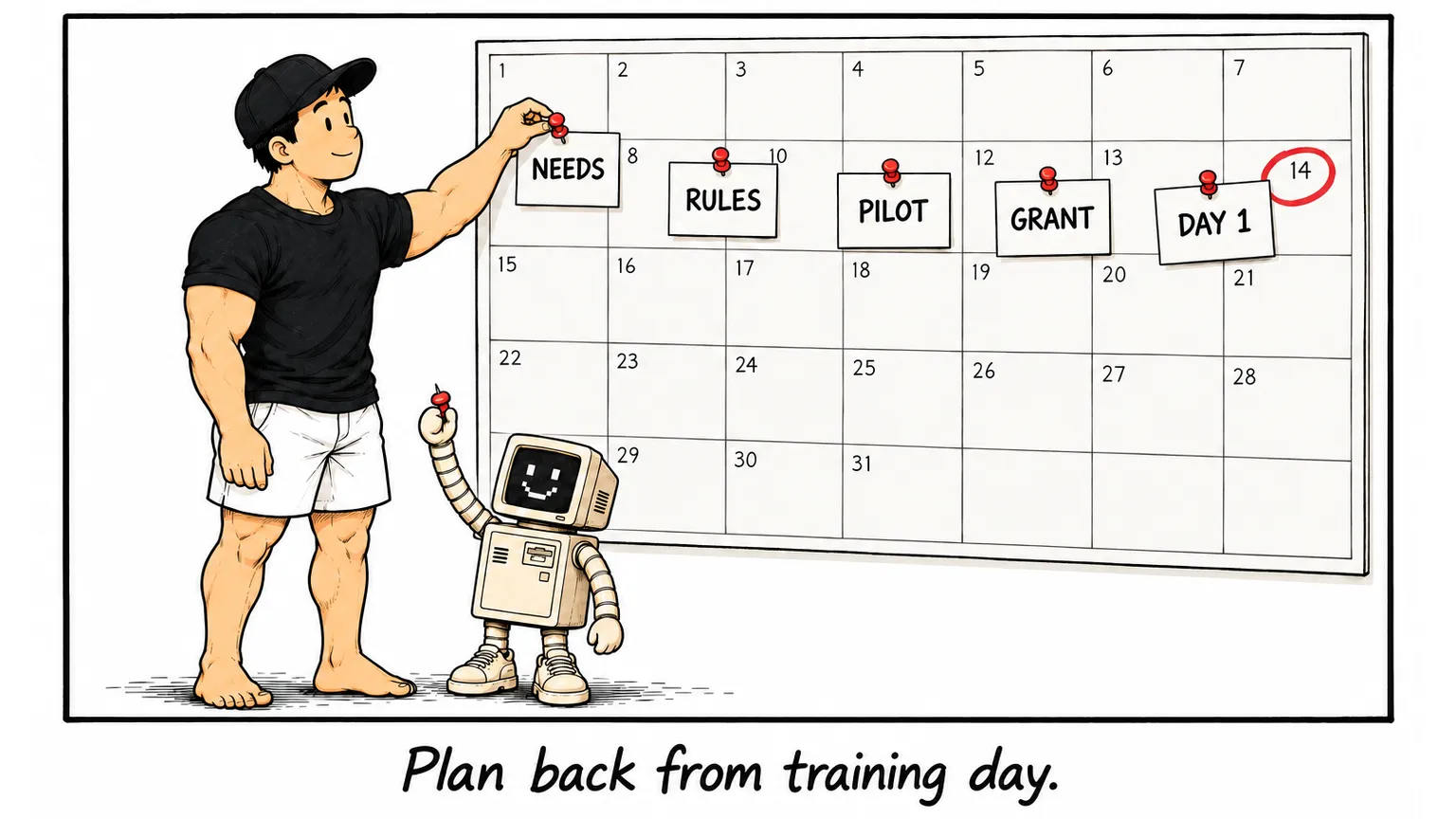
The AI CV screening workflow ran in ten steps, from the job ad to the hire, and a person owned six of them. The AI’s part was reading and ranking: it pulled the CVs, scored them and wrote a ranked report.
- 01 · PersonJob adPosted on Hiredly
- 02 · PersonRole profileWhat a good hire looks like, written down
- 03 · AutomatedPull and readEach CV PDF downloaded and its details extracted
- 04 · AutomatedScoreFive measures, 1 to 5 each, weighted into a score out of 10
- 05 · AutomatedReportRanked in two tiers: 0 to 1 year and 2+ years of experience
- 06 · PersonSpot checkSome CVs checked by hand against their scores
- 07 · PersonShortlistConfirmed before anyone is contacted
- 08 · AutomatedDraftsAn email and a WhatsApp nudge per shortlisted applicant
- 09 · PersonSendEvery message checked and sent by a person
- 10 · PersonInterview and hireTop candidates interviewed in person
Steps 3 to 5 and step 8 were automated with Claude. Nothing reached an applicant unless a person sent it.
I built the workflow because Hiredly’s applicant data was not complete enough to rank from. In my experience, its CSV export introduced errors such as extra characters and wrong email addresses, and some profile details were missing. So the AI extracted each applicant’s details from the CV PDF itself, added them to the Hiredly data, then scored every applicant.
I built it with Claude. In March it ran as scripts that sent each CV to Claude for scoring. By April the same steps were saved as a reusable Claude Code Skill: a set of instructions Claude follows each time a new batch of applicants arrives.
I teach teams to build workflows like this one, so I sell what this page describes. For workflows in other teams, see these practical AI workflow examples.
What happened, in numbers?
The workflow screened 300+ applications, and the client filled both open roles. The job ads were for marketing roles, from entry level to executive. The figures below come from the hiring records for March and April 2026.
In March, four job ads ran. After I confirmed the shortlist, 13 applicants got a first message.
In April, one ad drew 73 applicants between 2 and 23 April. All 73 were scored from the full text of their CVs, and 11 made the outreach list.
The April round
One job ad, applications from 2 to 23 April 2026
Each round ended in a report that a person could read in one sitting:
- A ranked table of every applicant, split into 0 to 1 year and 2+ years of experience
- A written profile for each applicant who scored 7 or higher
- Flags for a person to check, such as a CV the AI could not read
The 0 to 1 year tier was the main group the client was hiring from, so it got its own table.
What did the AI score against?
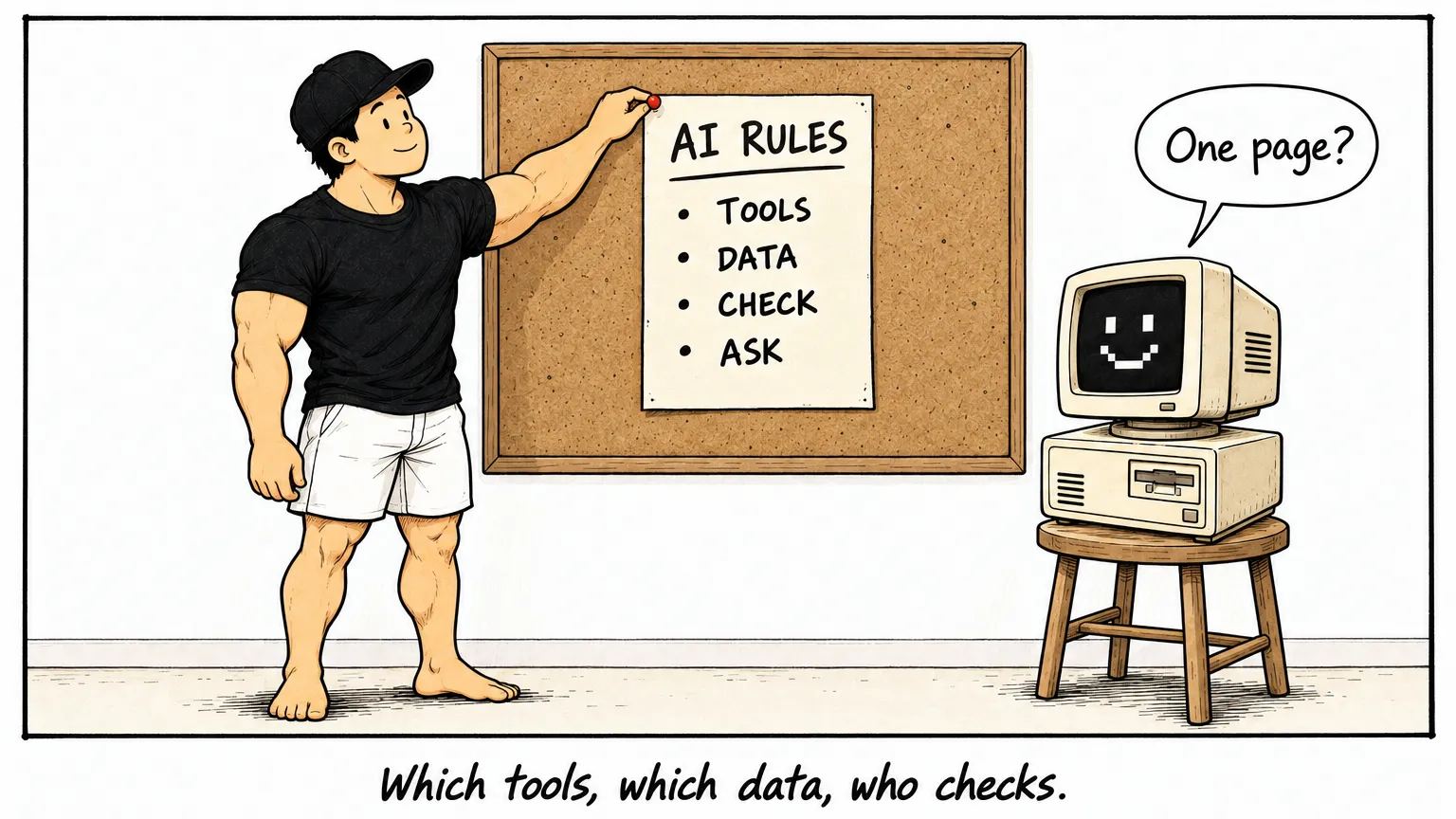
The AI scored every CV against a written role profile: the criteria that turn a job ad into a description of a good hire. It is the brief the AI works from, so it decides what every score means.
The profile had two hard rules. An applicant who broke either one did not progress, whatever the score.
- Hard rule
- Writes clear English
- Hard rule
- Can work from the office, or has a plan to move
Everything else moved the score up or down:
- Two strong types
- Creative first or analytics first. Score both fairly
- Scores up
- A portfolio, video editing, measurable results, side projects
- Small plus
- Any mention of using AI tools
- Scores down
- Repeated jobs under three months, or a CV with no specifics
Can ChatGPT or Claude write the job description?
Yes, either can draft a job description from your notes. In this case the job ad was already live before screening began, and the AI worked from the role profile, not the ad.
Spend your time on the profile. Every score follows from it, so a vague line there affects every applicant.
Who set the weights, and why does that matter?
A person sets the weights, and the weights decide who rises to the top of the ranking. The AI applies whatever weights it is given, the same way for every CV.
Each applicant got a score from 1 to 5 on five measures. The weights turned those into one score out of 10. I changed them between rounds:
| Measure | March | April |
|---|---|---|
| Availability | 25% | 20% |
| Role skills | 20% | 30% |
| Learning potential | 25% | 25% |
| Content or portfolio | 15% | 15% |
| Communication | 15% | 10% |
Try it on six invented applicants. Load each round’s weights, then move the sliders and watch the ranking change.
- 1Applicant DAgency executive with campaign results7.7/10
- 2Applicant CNew graduate with side projects7.4/10
- 3Applicant AEdits video, can start now7.3/10
- 4Applicant BRuns ad campaigns, three months notice7.2/10
- 5Applicant EFinal-year student, strong writer6.5/10
- 6Applicant FMoving over from a sales job6.3/10
Invented example. Not real applicants
| Applicant | Availability | Role skills | Learning potential | Content or portfolio | Communication | March weights | April weights |
|---|---|---|---|---|---|---|---|
| Applicant A | 5 | 2 | 4 | 5 | 3 | 7.7 | 7.3 |
| Applicant B | 2 | 5 | 4 | 2 | 4 | 6.8 | 7.2 |
| Applicant C | 5 | 2 | 5 | 3 | 4 | 7.9 | 7.4 |
| Applicant D | 3 | 5 | 3 | 4 | 4 | 7.4 | 7.7 |
| Applicant E | 2 | 3 | 4 | 3 | 5 | 6.6 | 6.5 |
| Applicant F | 4 | 3 | 3 | 2 | 4 | 6.5 | 6.3 |
Score out of 10 = the weighted average of the five scores, times 2.
With April’s weights, Applicant D comes first. Switch to March’s and Applicant C takes the top spot, with D down to third.
Bias is set here too. A heavy weight on availability favours people who can start now, which may be right for the role. Choose each weight on purpose, and write down why.
Did reading the full CV change the ranking?
Yes: in the April round, full-CV scoring rated 7 applicants at 7.5 or higher who were still marked undecided in Hiredly. It rated 4 applicants marked shortlisted there below 6.5.
Marked shortlistedMarked undecided
In Hiredly, 4 of these applicants were marked shortlisted and the other 7 undecided.
Scored 7.5 or higherScored below 6.5
Scored from their full CVs, the 7 marked undecided all reached 7.5 or higher. The 4 marked shortlisted all scored below 6.5.
Counts from the April round report. Each dot is one applicant, with no personal details.
Reading the whole CV lifted applicants still marked undecided, and questioned some marked shortlisted. I still confirmed the shortlist before anyone was contacted.
What went wrong, and what did I check by hand?
Three data problems surfaced during screening, and each one needed a check against the CV itself.
- Years of experience
- Worked out from job datesHiredly's field often read 0 for people with jobs listed on their CV
- Email addresses
- Checked against each CVHiredly's CSV export added extra characters to some addresses or got them wrong
- One unreadable PDF
- Flagged and read by a personText extraction failed on one CV
What I would do: In your first round, check every field the AI takes from a job board export against the CV itself. Fields that look tidy can still be wrong.
What did a person decide?
I set the role profile and the weights, and I confirmed the shortlist. Every message went out from a person, and the top candidates were interviewed in person before the client hired.
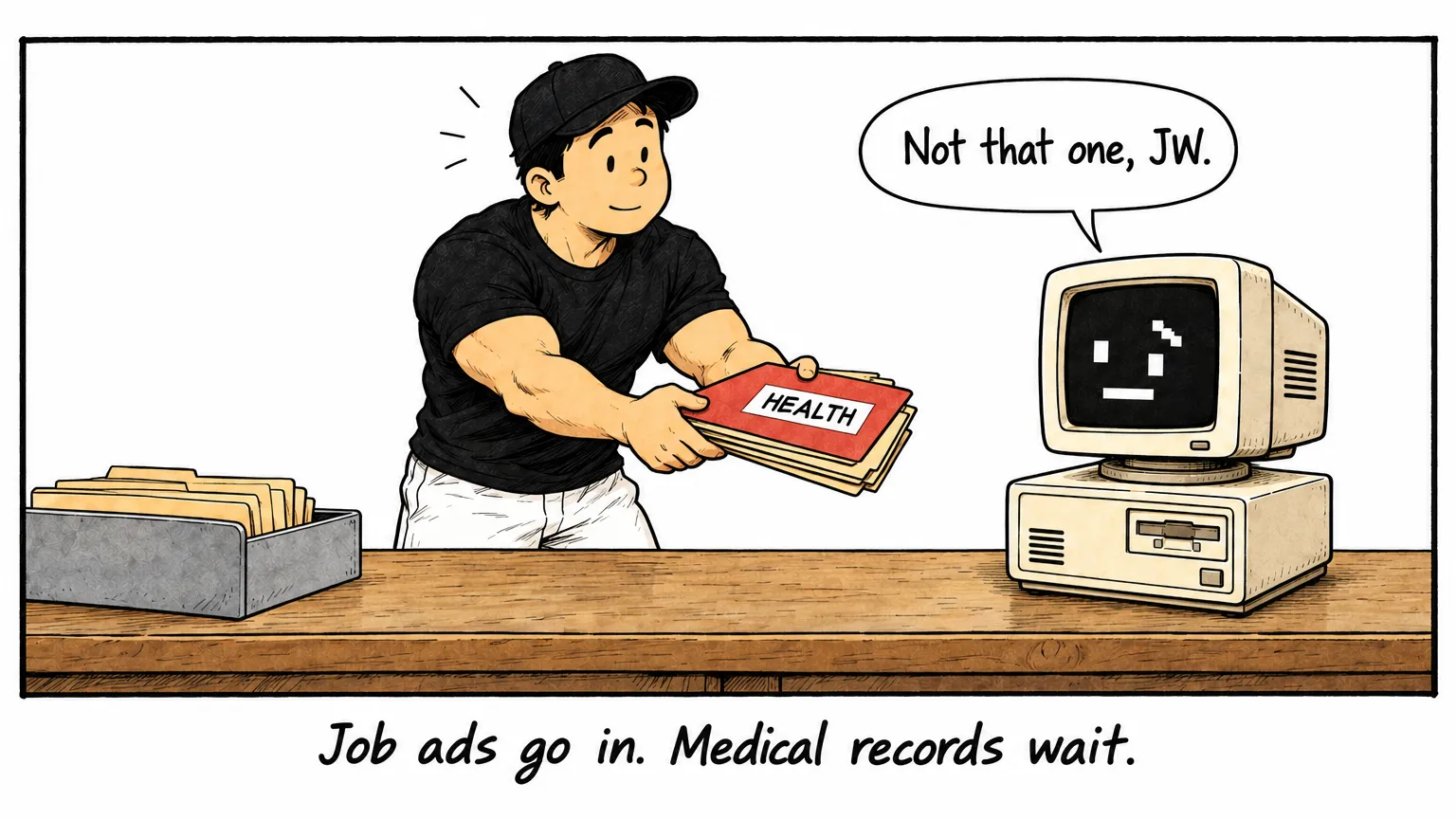
The workflow wrote outreach as drafts only, and never sent anything itself. Each email address was checked against the CV before a person sent the draft.
I checked some CVs by hand to confirm the AI had read them correctly and that the scores held up. Not every rejected CV was reviewed by a person, and applicants were not told AI was used. The next round adds both, as the last chapter sets out.
Use this list for your own process. Ticks stay saved in your browser.
Screening is one task in HR. To find which tasks to train your team on first, use a training needs analysis for AI skills. For the wider plan, see my AI upskilling plan for employees in Malaysia.
What does the next hiring round add?
The next round adds two steps this one did not have, both drawn from Malaysia’s new guideline: a written notice telling applicants that AI is used, and a person checking every rejection, not a sample. The data protection regulator now treats AI ranking of candidates as profiling, and as automated decision-making when people have little or no say in the result.
The timing in this case is close. The April round closed on 23 April 2026. On 30 April, the Personal Data Protection Department published its Automated Decision-Making and Profiling Guideline.
Its own HR example is an algorithm that ranks and shortlists candidates for interview. The guideline counts that as both automated decision-making and profiling, and it lists denying someone an employment opportunity as a decision with a significant effect.
| Check | What the guideline asks | This round | Next round |
|---|---|---|---|
| Notice | Tell applicants in writing that automated decisions or profiling are used (paras 9.2 and 9.3) | Applicants were not told | A written notice that AI is used |
| Human review | As best practice, AI is never the sole factor in a decision (para 10.2.6) | I confirmed the shortlist and checked a sample of CVs | A person checks every rejection |
| DPIA | Your data protection officer runs an impact assessment first (paras 1.3 and 6.1) | None on record | Done before the job ad goes live |
Whichever AI you use, run CVs through an account the company controls, and check whether the provider trains on what you put in.
Book the DPIA before the job ad goes live. For what PDPA allows when HR uses AI, read my guide to PDPA and AI in HR.
Questions HR managers ask about AI CV screening
Is it legal under PDPA to screen CVs with ChatGPT or Claude?
It can be, under conditions. The PDP Department’s guideline sets out when automated decisions may be made, expects a written notice and a DPIA, and recommends a person in the decision. My PDPA and AI in HR guide covers the rules.
Which AI is best for recruitment?
The method matters more than the tool. I used Claude. The role profile, the weights and the human checks decided the quality of the shortlist.
Will AI replace recruiters?
It did not in this case. The AI read and scored. I confirmed who to contact, and the top candidates were interviewed in person.
References
Show all 2 sources
The 300+ total is my own count. Other case figures come from the client's hiring records for March and April 2026. Guideline checked 24 Oct 2026.
- Personal Data Protection Department: Automated Decision-Making and Profiling Guideline (ADMP), published 30 Apr 2026. The guideline’s page.
- Automated Decision-Making and Profiling Guideline (PDF). The HR shortlisting example (para 4.2), significant effects including denied employment (paras 7.1 to 7.4), the DPIA (paras 1.3 and 6.1), notice (paras 9.2 to 9.5) and AI as never the sole factor (para 10.2.6).